

Technology
Ester-based Oil
The key raw material that defines HANABI’s quality.
Technology
Ester-based Oil
Manufactured control solution and Ester Base Oil
Lower Carbon emission with Ester-based Organic Friction
Modifier increases Energy Efficiency in Automotive Vehicles
The friction reduction mechanism of GMO transferred from physisorption to chemisorption,
which reduced friction coefficient at both low and high temperature.

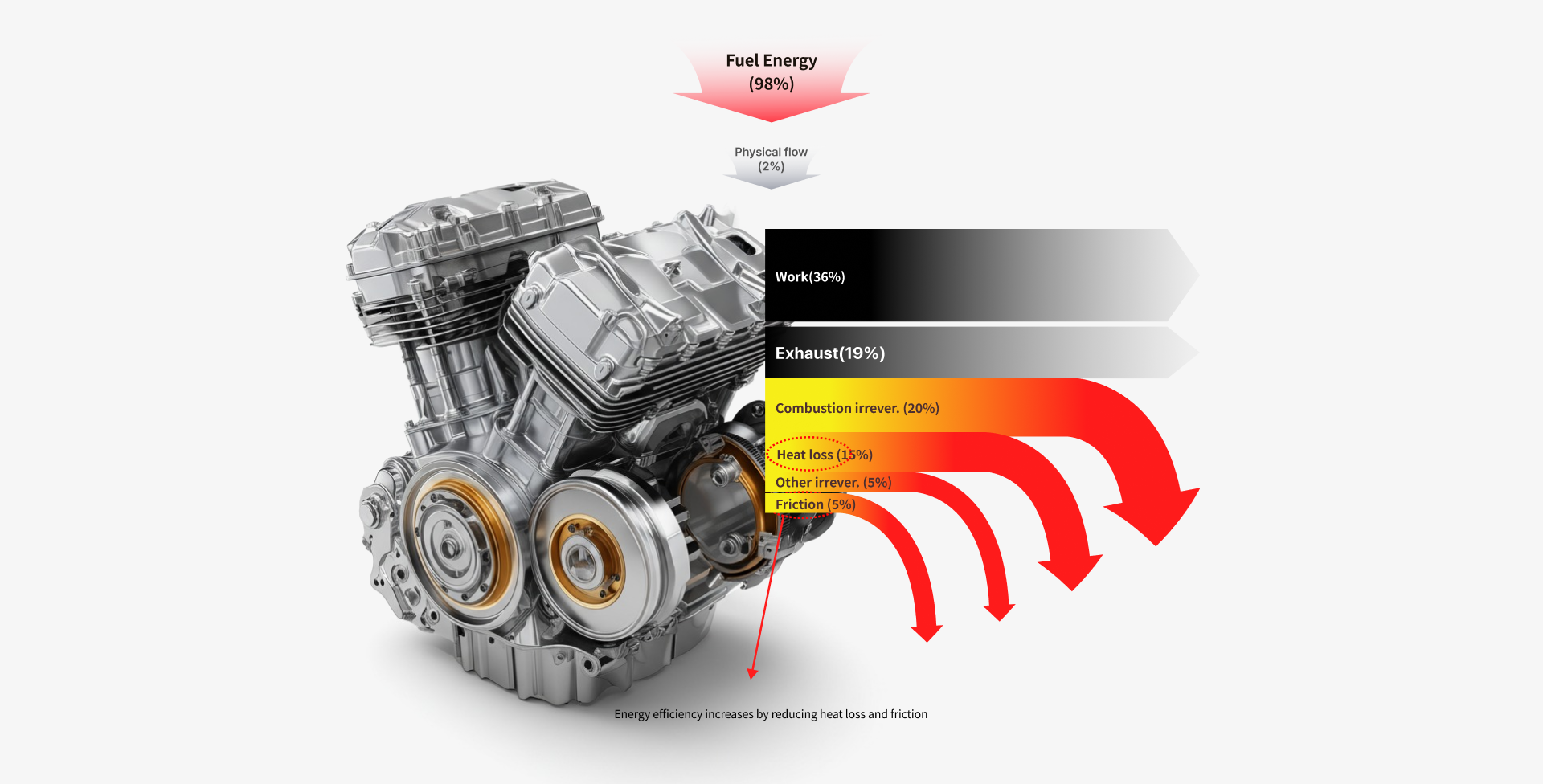
Energy efficiency improves by reducing friction losses.
By reducing half of the 20% loss caused by friction and heat among about 70% of the energy loss in the engine, overall energy efficiency can be increased by 10%.
Reduction in fuel by using the fuel-economy engine oil
reduces carbon emissions.
Every gallon of gasoline burned creates about 8,887 grams of CO2. About 2% in fuel reduction helps to reduces 178g of CO2 per gallon of gasoline.
Slowing down the thermal oxidation reaction makes the drain
interval of engine oil longer
The thermal oxidation process in engine oil is accelerated by frictional heat, metal catalysts, etc. It leads to increased viscosity and sludge formation and makes oil exchange time faster.

Organic Friction Modifier - GMO
(Glycerol Monooleate)
Glycerol monooleate (C21H40O4) is a clear amber or pale yellow liquid. It is an oil-soluble surfactant and is classified as a monoglyceride. It is used as an antifoam in juice processing and as a lipophilic emulsifier for water-in-oil applications. It is a moisturizer, emulsifier, and flavoring agent. Various forms of glycerol oleate are widely used in cosmetics and it is also used as an excipient in antibiotics and other drugs.
However, glycerol monooleate (GMO) has linear molecular structures, which significantly improve the tribological performance. GMO has been widely used in lubricant oils as a friction modifier, and excellent lubricating performances were observed, such as the ultra-low friction obtained between two metal surfaces with oil.
The Role of GMO in Lubricants
The friction reduction mechanism of GMO transferred from physisorption to chemisorption,
which reduced friction coefficient at both low and high temperature.

Energy Efficiency in Automotive Vehicle
Energy efficiency increases by reducing friction, leading to reduced
heat loss by minimizing frictional heat. Reducing friction is a very essential characteristic in engine oil.

Gasoline powered vehicle:
Around 80% of the energy is lost to various
inefficiencies
Data from FuelEconomy.gov
Image by Karin Kikr for yale Climate Connections
Engine Cylinder